
Mutual Funds Over 20 Years Old: Why the Old Guards Still Rule the Market
They say old is gold. Well, in the world of investing, that saying turns out to be literally true.
When it comes to mutual funds over 20 years old, these veterans have seen everything — dot-com bubbles, market crashes, pandemics, and political turmoil — yet they’ve stood tall, growing quietly and steadily.
And you know what’s fascinating? These funds don’t just survive; they thrive. They’ve turned small monthly investments into serious wealth for those who stayed patient. Let’s dive into why experience (and longevity) matters so much in the mutual fund universe.
Remember 2003? Mutual Funds Do.
Ah, 2003 — when cellphones had antennas, Internet cafes were the hangout spot, and mutual funds meant filling out lengthy paper forms at the bank.
Several of the funds that dominate today’s performance charts were already up and running back then. They’ve lived through the 2008 global recession, the 2020 lockdown market crash, and countless ups and downs in between.
That’s what makes them reliable. While newly launched funds are like startups full of enthusiasm, the 20-year-old ones are the seasoned entrepreneurs who’ve survived multiple economic earthquakes and still deliver returns.

Why Old Mutual Funds Deserve Your Attention
Let’s face it — the world of mutual funds can feel like online dating. New ones pop up all the time, promising better returns, unique strategies, and fancy marketing. But when you think long-term, the ones that age gracefully usually win your heart (and your portfolio).
Here’s why you should pay attention to mutual funds over 20 years old:
-
Proven resilience: They’ve handled multiple market cycles and know how to adapt.
-
Strong fund management lineage: Decades of professional expertise refine their strategy.
-
Track record transparency: You can study 15–20 years of data before investing.
-
Compounding power: They’ve been compounding quietly for two decades — the ultimate wealth builder.
-
Investor trust: Thousands (if not millions) of investors have stayed invested for a reason.
Honestly, in finance, time is the best credibility certificate you can have.
My First Tryst with an “Old” Mutual Fund
A little detour here. Back in 2015, I hesitated to invest in mutual funds because I didn’t understand them. A friend — a finance nerd — told me, “Pick something that’s been around longer than you’ve been working. If it’s survived that long, you’re good.”
So, I looked up HDFC Equity Fund, which launched in 1995. That fund had weathered everything you could imagine. I started a tiny SIP of Rs. 2,000/month. Fast forward to 2025 — it’s grown steadily with an impressive long-term CAGR, and more importantly, it never gave me sleepless nights.
That’s the beauty of age in mutual funds — they don’t try to impress; they just keep delivering.
Top Mutual Funds Over 20 Years Old (and Still Thriving in 2025)
Here are some veteran mutual funds that have more experience handling market volatility than most of us have in handling Monday mornings.
| Fund Name | Launch Year | Category | 10-Year CAGR | Long-Term Rank |
|---|---|---|---|---|
| HDFC Equity Fund | 1995 | Multi-Cap | 13.4% | Excellent Consistency |
| Franklin India Bluechip Fund | 1993 | Large Cap | 12.8% | Strong Longevity |
| ICICI Prudential Value Discovery Fund | 2004 | Value | 15.2% | Stable Performer |
| UTI Nifty Index Fund | 2000 | Index | 12.0% | Reliable Tracker |
| SBI Contra Fund | 1999 | Contra (Value) | 16.1% | Outperformed Benchmark |
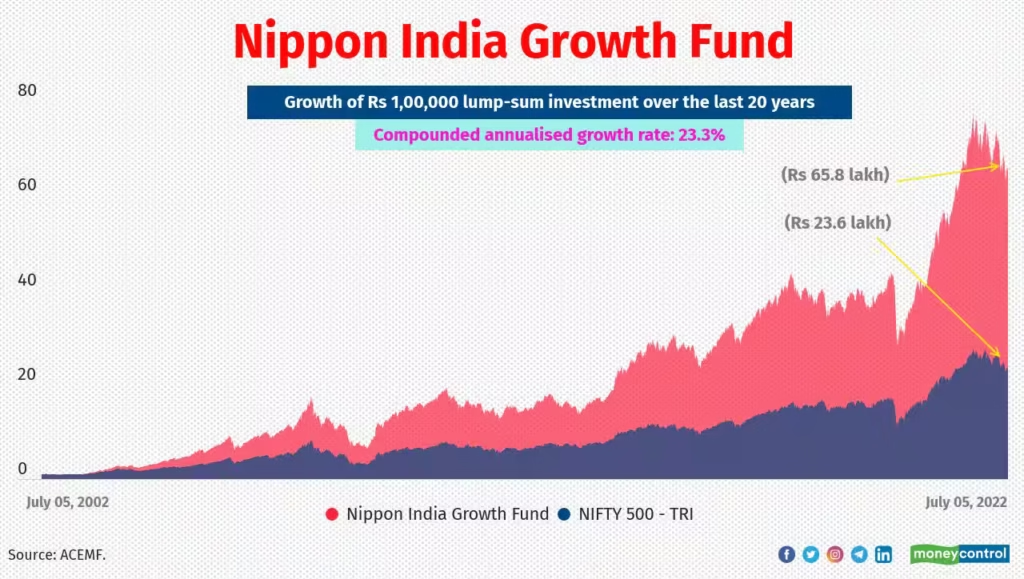
| Reliance (Nippon) Growth Fund | 1995 | Mid Cap | 15.8% | High Growth Potential |
| Templeton India Equity Income Fund | 2003 | Value | 13.7% | Consistent Dividends |
| Axis Long Term Equity Fund | 2005 | ELSS (Tax Saving) | 14.1% | Trusted for Tax Benefits |
These mutual funds have cruised through decades of market uncertainties and still continue to deliver positive results year after year.
By the way, some of these funds hold assets older than your first smartphone — that’s how deep their experience runs.
The Story of Resilience: How These Funds Stand the Test of Time
Longevity in mutual funds isn’t luck; it’s strategy. Let’s unpack what’s behind that consistency.
Diversification Done Right
Most old funds maintain a balance — spreading investments across sectors so no single shock tanked them completely. Think of it like a cricket team where every player can bat a little; even if one fails, the others can rescue the game.
Fund Manager Evolution
Over 20 years, fund houses have passed the baton between multiple fund managers. Each new manager blends experience with fresh ideas. The result? A time-tested investment philosophy with adaptability.

Handling Crises
Whether it was the 2008 financial crash or the sharp COVID fall, these funds didn’t jump ship. They doubled down on quality stocks and reaped rewards in the recoveries that followed.
Experience teaches you not to panic when markets melt. And these funds have mastered that art.
The Average Investor’s Dream: Steady Compounding
Let’s put things in perspective. Imagine starting a monthly SIP of Rs. 1,000 in 2003 in a top-performing 20-year-old mutual fund.
By 2025, you’d have invested Rs. 2.64 lakh, but your corpus could be over Rs. 12–13 lakh at around 15% annual returns.
By the way, no complex trading skills, no sleepless nights watching stock charts — just old-school patience.
That’s why I call these funds “silent overachievers.”
The Longevity Edge: Why Old Funds Often Beat New Funds
There’s something deeply reassuring about mutual funds with two decades of market exposure. Let’s break down a few reasons why they often outperform newer funds:
-
Proven strategy: Their process and algorithms have survived multiple reforms, rate hikes, and global economic shocks.
-
Predictable behavior: You can analyze real past performances, not projections.
-
Stable investor base: Less panic selling during downtrends keeps fund volatility lower.
-
Efficient expense management: Over time, fund houses streamline costs, improving investor experience.
By contrast, newer funds sometimes experiment too much or chase hot trends before finding their footing.
Old funds? They’ve already found their rhythm — and it shows.
But Wait — Are All Old Mutual Funds Worth Investing In?
Not necessarily. Age doesn’t automatically mean greatness (same goes for fine wine and relationships).
Here are situations where old funds might not shine:
-
Over-diversification: Some old funds play it too safe, spreading too thin across sectors.
-
Inertia: A few become complacent, relying on reputation rather than innovation.
-
Underperformance: Even seasoned funds can lag newer entrants temporarily due to sector rotation.
So yes, while history matters, you still need to check recent returns, manager track record, and consistency before committing.

A Quick Tip: The “Three-M Test” for Old Mutual Funds
Whenever I evaluate an old mutual fund, I use what I call the Three-M Test — Management, Momentum, and Market-fit.
-
Management: Has the fund house retained experienced managers or replaced them wisely?
-
Momentum: Is it still beating or matching its category peers over 3–5 years?
-
Market-fit: Is it adapting to new sectors like EVs, AI, or fintech, or stuck in old favorites?
If a fund passes these three, it’s usually worth holding or starting fresh investments in.
Expert Insights: What the Pros Say
According to Morningstar analysts, mutual funds with a 15–20+ year track record and consistent risk-adjusted returns “tend to outperform during challenging times due to disciplined frameworks.”
Even fund managers admit — experience adds intuition. They’ve seen enough cycles to know when to stay put and when to make subtle shifts.
That’s also why many experts recommend having at least one decade-old or older mutual fund in your portfolio — for balance, reliability, and trust.
Comparing Veterans vs. New-Age Funds
| Criteria | 20+ Year Funds | New-Age Funds |
|---|---|---|
| Track Record | Extensive historical performance | Limited data |
| Stability | Proven across multiple cycles | Yet to be tested |
| Innovation | Slower to adapt to trends | Quicker experimentation |
| Risk Profile | Lower volatility | Higher due to youth |
| Ideal For | Long-term, conservative investors | Aggressive, experimental investors |
Honestly, having a mix of both is ideal. One gives you calm consistency; the other keeps your returns spicy.
Common Myths About Old Mutual Funds
Let’s bust some misconceptions that deserve retirement themselves.
-
Myth 1: Old funds give low returns.
Truth: Many old funds consistently outperform benchmarks due to active management. -
Myth 2: They’re too large to grow further.
Truth: Larger AUM doesn’t always hinder returns — diversification keeps performance steady. -
Myth 3: They’re outdated.
Truth: Veteran funds continuously rebalance portfolios with new-age stocks like tech, AI, and renewable energy.
Age equals wisdom, not obsolescence.
SIPs + Old Funds: A Match Made in Financial Heaven
The beauty of SIPs (Systematic Investment Plans) in old mutual funds is that you’re combining two time-tested wealth-building tools.
Every SIP installment benefits from:
-
Long-term compounding
-
Market recovery phases
-
Automatic rupee-cost averaging
Whether markets skyrocket or stumble, these old funds have seen it all. They absorb shocks better and reward patience more than most.
FAQs About Mutual Funds Over 20 Years Old
1. Are 20-year-old mutual funds better than newer ones?
Not always, but they tend to be more stable and predictable due to their long history and data availability.
2. How can I check which mutual funds are over 20 years old?
You can find the inception year on AMC websites or financial portals like Value Research and Morningstar.
3. Can old funds still deliver 15–18% returns today?
Yes, some do. Performance depends on the category — small-cap and flexi-cap funds often exceed 15% CAGR.
4. Is it wise to switch from an old fund to a new one?
Only if the old fund underperforms persistently for over 2–3 years despite market recovery.
5. How often should I review old mutual funds?
Once every 6–12 months — to assess performance consistency and check if they align with your goals.
Final Thoughts: Time Is the Greatest Fund Manager
In investing, patience beats prediction.
Mutual funds over 20 years old prove that time builds trust, returns, and credibility better than any hype ever could. They’re like the seasoned coaches of your financial team — disciplined, tested, and quietly brilliant.
So, if you’ve been thinking of where to park your hard-earned money safely yet efficiently, start by looking at these old champs. They’ve already done the hard work of surviving; all you need to do is give them your time.
Your Turn:
Do you own (or plan to invest in) any mutual funds older than 20 years? Drop a comment below — I’d love to hear which one’s your long-term favorite and why.