What is the Jan Samarth Loan Portal?
Jan Samarth is a unified digital portal that connects you directly with multiple banks and NBFCs offering credit-linked government schemes on a single platform. Instead of visiting different bank websites or branches, you can check eligibility, choose schemes, and apply for loans online in one place.
The portal currently hosts multiple central government-linked schemes under categories like education, business, agriculture, livelihood, renewable energy and more. The idea is simple: inclusive growth, less paperwork, and faster, more transparent approvals using digital verification and smart analytics.
Why Jan Samarth Is a Game-Changer
Think of Jan Samarth as the “IRCTC of government loans” – one window, many options, and everything digital. Instead of guessing which scheme fits you, the portal actually recommends suitable schemes based on your details and requirements.
Key benefits include:
-
Single platform for multiple government loan schemes.
-
Online eligibility check, application, document upload, and status tracking.
-
Auto-recommendation of best-matching schemes, saving time and confusion.
Honestly, for students, small business owners, and farmers who hate paperwork, this is a breath of fresh air compared to old-school branch visits.
Types of Loans You Can Apply For
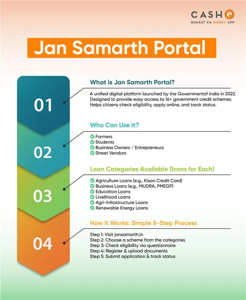
Jan Samarth isn’t just “one more education loan site”; it covers a wide spectrum of needs. Here’s a quick snapshot of major loan categories available on the portal.
Education Loans
Students can access education loans linked to central schemes and interest subsidy programs for higher studies in India or abroad. The portal helps map you to schemes based on your course, institution, income bracket, and category (like EBC/OBC where relevant).
Many education schemes on the portal offer interest subsidies for economically weaker sections, reducing the overall cost of borrowing during the moratorium period.
Business / MSME Loans
Entrepreneurs, startups, and MSMEs can find credit-linked schemes supporting manufacturing, services, self-employment, and expansion. Examples include schemes like PMEGP, MUDRA-linked options, Stand-Up India, and others that are commonly routed through partner banks on the platform.
The focus is on generating employment, encouraging self-employment, and making formal credit more accessible to small and micro enterprises.
Agriculture & Agri-Infrastructure Loans
Farmers can apply for credit to improve agri infrastructure, buy equipment, or manage post-harvest needs, depending on the scheme. There are also specialized offerings like warehouse receipt–backed financing under e‑Kisan Upaj Nidhi for produce stored in WDRA-registered warehouses.
Livelihood & Self-Employment Loans
There are schemes under livelihood and rural missions that target self-help groups, rural households, and self-employed individuals to boost income-generating activities. For many low-income families, these loans become the stepping stone from daily wage work to small, stable enterprises.
Renewable Energy & Special Categories
The portal also includes categories like renewable energy loans for rooftop solar and other green initiatives, routed through dedicated schemes. Over time, the number of schemes and categories has grown, covering more than a dozen government programs and hundreds of lenders.
Basic Eligibility for Jan Samarth Loans
Eligibility depends on which scheme and loan category you choose, but a few broad patterns keep showing up.
Common requirements usually include:
-
Being an Indian citizen.
-
Meeting scheme-specific income, category, or occupation criteria (student, farmer, entrepreneur, etc.).
-
Having the required documents like Aadhaar, income proof, admission letters, land records, or business registration, as applicable.
For education loans, for example, you typically need confirmed admission in a recognized institution and often a co-applicant like a parent or guardian. Some subsidy schemes also set income ceilings, such as annual family income not exceeding certain limits for EBC or OBC categories.
Step-by-Step: How to Apply for Jan Samarth Loan Online
If you came here specifically for “how to apply Jan Samarth loan online,” this is your mini blueprint.
Step 1: Visit the Official Portal
-
Go to the official website at jansamarth.in using your browser.
-
Make sure the URL is correct to avoid phishing or fake portals.
Step 2: Explore Schemes and Choose Loan Category
-
Click on “Schemes” or loan categories like Education, Business, Agriculture, Livelihood, etc.
-
Open the category that matches your need and read the basic overview, benefits, and eligibility conditions.

Step 3: Use the Eligibility Checker
-
Most categories allow you to check your eligibility by answering a few simple questions online.
-
Once you enter details such as income, location, course/business type, or landholding, the portal suggests suitable schemes you can apply for.
Step 4: Register on the Portal
-
Click on “Apply Now” for the chosen scheme or category.
-
Complete registration using your mobile number, Aadhaar, and basic details, verifying via OTP.
Step 5: Fill the Online Application
-
Fill in your personal, academic, business, or farm details as required for that scheme.
-
Upload scanned copies of required documents like ID proof, address proof, income proof, admission letter, business registration, land documents, etc.
Step 6: Submit and Note Application ID
-
Review the form carefully and submit it online.
-
You’ll receive an application or reference number that you should save for future tracking.
Step 7: Track Your Loan Status
-
Log in to your Jan Samarth account and go to the “My Applications” or similar section.
-
You can see whether your application is under review, approved, or needs more information.
Documents Required (Typically)
The exact list changes with each scheme, but here are some documents commonly needed across categories.
For individuals (generic):
-
Aadhaar, PAN, and recent photograph.
-
Address proof such as utility bill, voter ID, etc.
-
Income proof like salary slips, ITR, or income certificate depending on scheme type.
For education loans:
-
Admission letter from recognized institute, fee structure, and previous mark sheets.
-
Co‑borrower KYC (usually parent/guardian) and their income documents.
For business/MSME loans:
-
Business registration documents, GST details, bank statements, and project or business plan if required.
For agriculture:
-
Land records, crop details, or storage/warehouse documents for schemes like e‑Kisan Upaj Nidhi.
Who Should Seriously Consider Jan Samarth?
Not everyone needs a government-subsidized loan, but for certain profiles, it’s almost a no‑brainer.
Jan Samarth is ideal if you are:
-
A student from a low or middle-income family planning higher studies and looking for interest subsidies.
-
An MSME owner or aspiring entrepreneur needing capital with government-backed schemes and support.
-
A farmer or agri-entrepreneur looking for structured, formal credit instead of informal high-interest sources.
-
A self-employed or rural household targeting livelihood or self-help group–based schemes.
For many users in these segments, Jan Samarth reduces the “where do I even start?” confusion that usually blocks them from approaching formal finance.
Online Application Experience: What It Feels Like
The portal is designed so that even first-time users can navigate without getting lost in banking jargon. Eligibility checks are question-based, and the interface guides you step by step—from registering to uploading documents.
Digital verification and backend integrations with multiple lenders help speed up decision-making, compared to old-style file processing. And because you can track your application online, you’re not stuck calling a branch every week asking, “Sir, file aage badha kya?”

Pro Tips Before You Hit “Apply Now”
A little prep before applying can save days of back-and-forth. Here are some practical tips aligned with how the portal and schemes work.
-
Check your credit history: Many bank-linked schemes still look at your or co-borrower’s repayment track record.
-
Organize all documents: Keep soft copies (PDF/JPEG) of KYC, income proof, admission letters, registrations, etc., ready before starting.
-
Read the scheme fine print: Each scheme may have extra conditions like income ceilings, course eligibility, location, or category criteria.
-
Compare lenders: Multiple lenders may offer the same scheme on the portal; interest rates and service levels can still differ.
-
Avoid mismatched info: Ensure details in your documents and application form match exactly to reduce verification delays.
Common Mistakes People Make (And How to Avoid Them)
Plenty of applicants trip over small but costly mistakes. These are worth avoiding.
-
Applying under the wrong category: For instance, using a generic business scheme when a better startup‑specific scheme exists for your profile.
-
Ignoring income or category limits: Applying for subsidy schemes when your family income clearly exceeds the cap wastes time and leads to rejection.
-
Incomplete document upload: Many applications get stuck simply because one document is blurred, expired, or missing.
-
Not checking application status: People apply once and then forget to log in and respond to queries or clarifications from lenders.

Is Jan Samarth Better Than Instant Loan Apps?
Jan Samarth and typical “instant loan apps” don’t really serve the same purpose, even though both are online. Instant apps usually offer small-ticket, short-tenor loans at comparatively higher interest for quick cash needs.
Jan Samarth, on the other hand, focuses on structured, government-backed credit like education, agri, and MSME loans that may include subsidies and policy support but may take more documentation and evaluation. If you’re building long-term assets (degree, business, farm infrastructure), Jan Samarth-style loans are generally more suitable.
Quick FAQ for Featured Snippets
1. What is Jan Samarth loan?
Jan Samarth loan refers to government-backed credit schemes accessed through the Jan Samarth portal, a unified online platform that connects borrowers with banks and NBFCs for education, business, agriculture, livelihood, and other loan categories. The portal simplifies eligibility checks, scheme selection, online application, and digital approval in one place.
2. How to apply for Jan Samarth loan online?
To apply online, visit jansamarth.in, choose the relevant loan category, use the eligibility checker, register with your mobile/Aadhaar, fill in the application form, upload documents, submit, and then track your status through the portal dashboard. The system recommends suitable schemes based on your inputs and forwards your application to participating lenders.

3. Who is eligible for Jan Samarth loans?
Students, farmers, MSME owners, self-employed individuals, and other eligible citizens can apply, subject to scheme-specific conditions on income, occupation, course, institution, or business profile. Many subsidy schemes have income ceilings and category requirements that you must satisfy to qualify.
4. Is Jan Samarth a government portal?
Yes, Jan Samarth is a government-supported digital platform designed to provide a common interface for availing multiple central government credit-linked schemes. It integrates with partner banks and financial institutions to streamline loan processing and improve transparency.
5. Can I track my Jan Samarth loan status online?
Yes, once registered, you can log in to the portal and check the status of your applications under the “My Applications” or similar section. Any updates, approvals, or additional information requests from lenders are visible through this online dashboard.
6. Is there a Jan Samarth mobile app?
A Jan Samarth applicant app is available on major app stores, allowing users to access portal features like scheme information and account services through mobile devices. Availability and features may evolve, so it’s always best to verify via the official listing and the main portal.
Final Thoughts and Call-to-Action
If you’ve been postponing your education, delaying a business expansion, or parking your dream solar setup just because “loan lena mushkil hai,” Jan Samarth gives you a structured, digital way to move forward. It won’t magically approve every application, but it does remove a lot of guesswork, middlemen, and unnecessary branch hopping.
Thinking about applying? Start with a quick eligibility check on the portal and see which schemes you qualify for. If you want, share in the comments what type of loan you’re planning to apply for (education, business, agriculture, etc.) and what’s confusing you most—future content can break down those parts step by step with real-world examples